
Becoming a record dealer.
June 1, 2026[2] BECOMING A DEALER:
In the Autumn of 1968, I was living in Bournemouth and working contentedly as a bus driver, which left me plenty of free time to trawl the local junk shops at least two or three times a week. I could continue on the buses, while accumulating interesting old records and hopefully selling them at a profit via adverts in Record Mart and elsewhere.
At this time, record collecting was in its infancy, especially collecting 7” records. For many years, there had been a thriving market for old Jazz & Blues 78s, in fact the Gramophone Company [EMI] had been reissuing ‘in demand’ pre-war jazz records of both New Orleans and Mainstream Jazz on 78s since the 1930s.
Record Mart magazine was started in 1967 by Frank Bailey, the publisher of Vintage Record Mart Monthly, a 78 listing magazine. Frank [later assisted by local collector Derek Glenister], perceived a growing interest in 7” records and so Record Mart was born. Up to that time a few dealers were sending out mimieographed record listings of what they had for sale. Finding customers, through small ads in NME, Melody Maker, Disc & Record Mirror as well as in Exchange & Mart, a kind of printed equivalent of EBay with a huge weekly circulation.
Prior to placing my first advert in Record Mart, I had already dipped my toes into the mail-order business, selling rare(ish) British coins. Working on the buses with decimalisation looming, put me in the ideal position to accumulate a stock of unusual UK coinage. A lot of older people were panicking and getting rid of their old coins, especially Edwardian & Victorian ones and many of these ended up being used to pay bus fares. I had a deal going with quite a few drivers & conductors, paying them 5 or 10 times face value for specific coins.
Coin collectors were ahead of the game, when compared to record collectors as there was an established magazine COIN MONTHLY, which apart from editorial had lists of records for sale and also published an annual price guide. This was a great help in figuring out what to charge for any of the coins that I managed to sell.
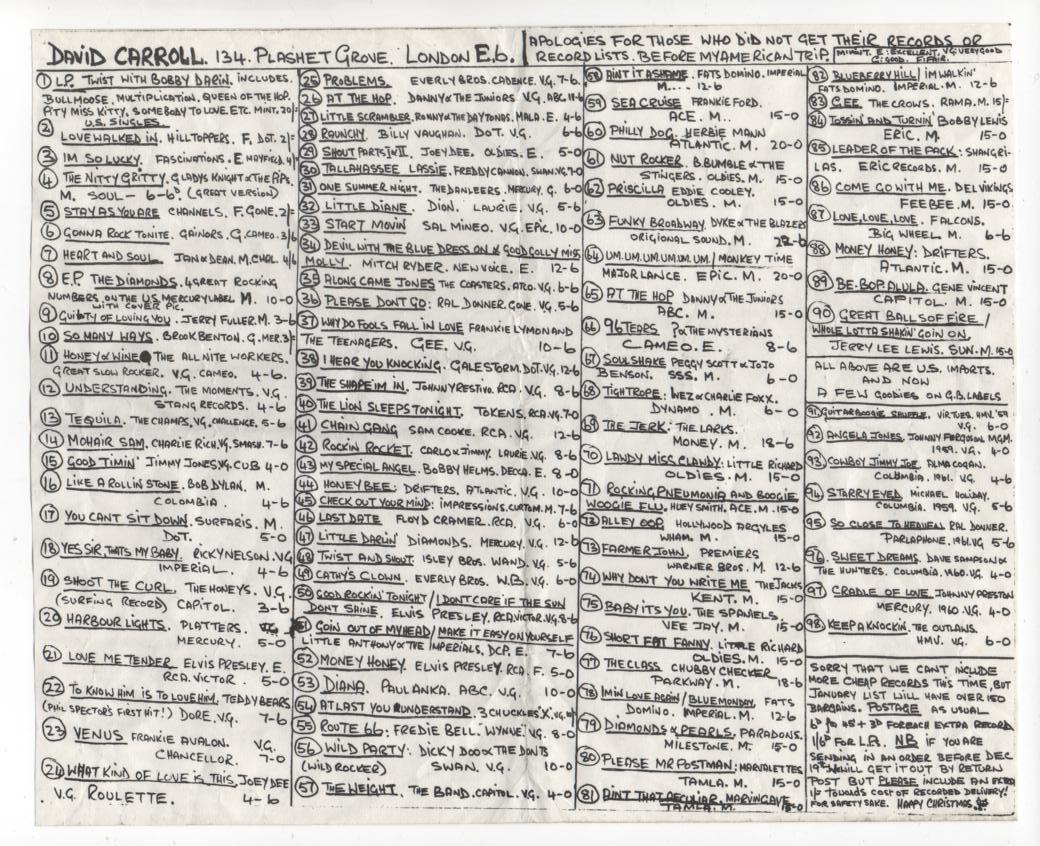
After “Mr Lee”, it was a no brainer to switch to dealing in records instead of coins which was of course much more stimulating for me. I placed my first advert in Record Mart sometime in the Autumn of 1969 and got encouraging results. I figured out appropriate prices by comparing my records for sale, with what other dealers were charging for similar records. From the 2 lists below, you can see that I was keeping things on the low side.
In June 1970, I quit my job with Bournemouth Corporation Transport and moved to to London to accept a job as tour manager with the leading Irish rock band SKID ROW [Gary Moore, Brush Shiels & Nollaig Bridgeman] all first class musicians. The band had just been taken under the wing of a leading UK management company fronted by Clifford Davis, who already managed Fleetwood Mac and Duster Bennett. The band had a record deal with CBS and had recorded their first album. Skid Row moved from Dublin to London to commence UK dates in support of the first album, which was due for release in September.
I found the band a 4 bedroomed house to rent for £10 a week at 134 Plashet Grove, East Ham. Skid Row rehearsed 2 or 3 days a week mostly in the house and undertook an average of 3 or 4 gigs a week throughout England, as well as a short Scandinavian tour in October.
But, what we were all really looking forward to was a one-month tour of the USA in November. Actually, this was the principal reason that I had taken the job with Skid Row. While the band was rehearsing, I had plenty of time to troll around many of the junk shops of East London, gradually accumulating even more stocks of interesting old 45s as well as expanding my personal collection.
One day, while browsing a table outside a junk shop in Newham, I engaged in conversation with a guy several years younger than myself who was wearing a shabby drape jacket. He told me about the Black Raven, a pub in Bishopsgate where the customers were all Teds and the jukebox contained only Fifties rock’n’roll records. This encouraged me that I was on the right track focusing mainly on records from the 1950s.
I sent out another [hand lettered / photocopied] mail-order list and by then we were Heathrow bound, next stop L.A.X.
Browse through our records:
- Records198 products
- 45s198 products
- 50s-RnR1 product
- Avantgarde1 product
- Bluegrass1 product
- Blues – Jazz1 product
- Blues6 products
- Cajun3 products
- Christmas1 product
- Comedy1 product
- Country3 products
- Country Rock2 products
- Cowpunk1 product
- Disco1 product
- Doo-Wop6 products
- Folk Rock3 products
- Funk8 products
- Garage Rock2 products
- Gospel1 product
- Hard Rock2 products
- Indie8 products
- Indie Rock1 product
- Indy1 product
- instrumental1 product
- Jazz vocals1 product
- Jump Blues4 products
- Latin Jazz1 product
- Metal2 products
- Metal – Heavy Rock2 products
- Mod3 products
- Mod – New Wave1 product
- Neo-Rockabilly5 products
- New Wave4 products
- New Wave23 products
- New Wave – Rock1 product
- New Wave – Ska1 product
- Pop20 products
- Pop – Rock – New Wave.1 product
- Pop Rock1 product
- Post Punk1 product
- Power1 product
- Power Pop6 products
- Prog Rock1 product
- Psychedelic Rock1 product
- Psychobilly3 products
- Pub Rock6 products
- Pub Rock – Rhythm & Blues2 products
- Punk16 products
- Punk-New Wave5 products
- Reggae12 products
- Reggae / Ska1 product
- Rhythm & Blues1 product
- Rock11 products
- Rock'n'Roll13 products
- Rock'n'Roll revival2 products
- Rockabilly8 products
- Singer – songwriter2 products
- Singer – songwriter – Country – Pop1 product
- Sixties psych1 product
- Sixties Punk – Garage1 product
- Ska6 products
- Soul8 products
- Soul – Funk2 products
- Soul – Northern1 product
- Soul – R&B2 products
- Soundtrack1 product
- Spoken Word Interview1 product
- Swamp Pop4 products
- Synth-Pop2 products
- Teen Pop.1 product
- Tex Mex1 product
- World Music1 product
- Zydeco4 products
- Posters8 products
- T-shirts6 products